

Choosing an rConfig HA architecture
With recovery targets agreed, the choice of architecture usually comes down to a few questions. This page walks through them and points to the design that fits.
Four questions
- Is a restore from backup fast enough? If the RTO is measured in hours, a single server with tested backups is the simplest answer. Stop here.
- Can both nodes share a Layer 2 segment? If yes, a keepalived VIP is the simplest failover. If not (different subnets, cloud), use a load balancer in active/passive mode or a cloud provider’s failover address.
- Must rConfig survive losing the whole site? If yes, the passive node and replicas go in a second site, with the replication latency and split-brain protection that needs.
- Is the problem capacity, or blast radius, rather than failover? If one server can’t carry the inventory, or one outage mustn’t affect every device, use several independent servers or Vector, each of which can be an active/passive pair.
The designs
| Design | Use when | Where it’s covered |
|---|---|---|
| Single server with backups | RTO of hours is fine | Backups |
| Active/passive pair | You need failover in minutes in one site. The standard design | Active/passive pair |
| Active/passive across two sites | You must survive losing a site | The active/passive pair, with the passive node and replicas in the second site |
| Several independent servers | Capacity or blast radius, not failover | HA options: scaling out is not HA |
| Vector | Distributed collection under one view, across customers or countries | Vector Server, Central Manager and Prism |
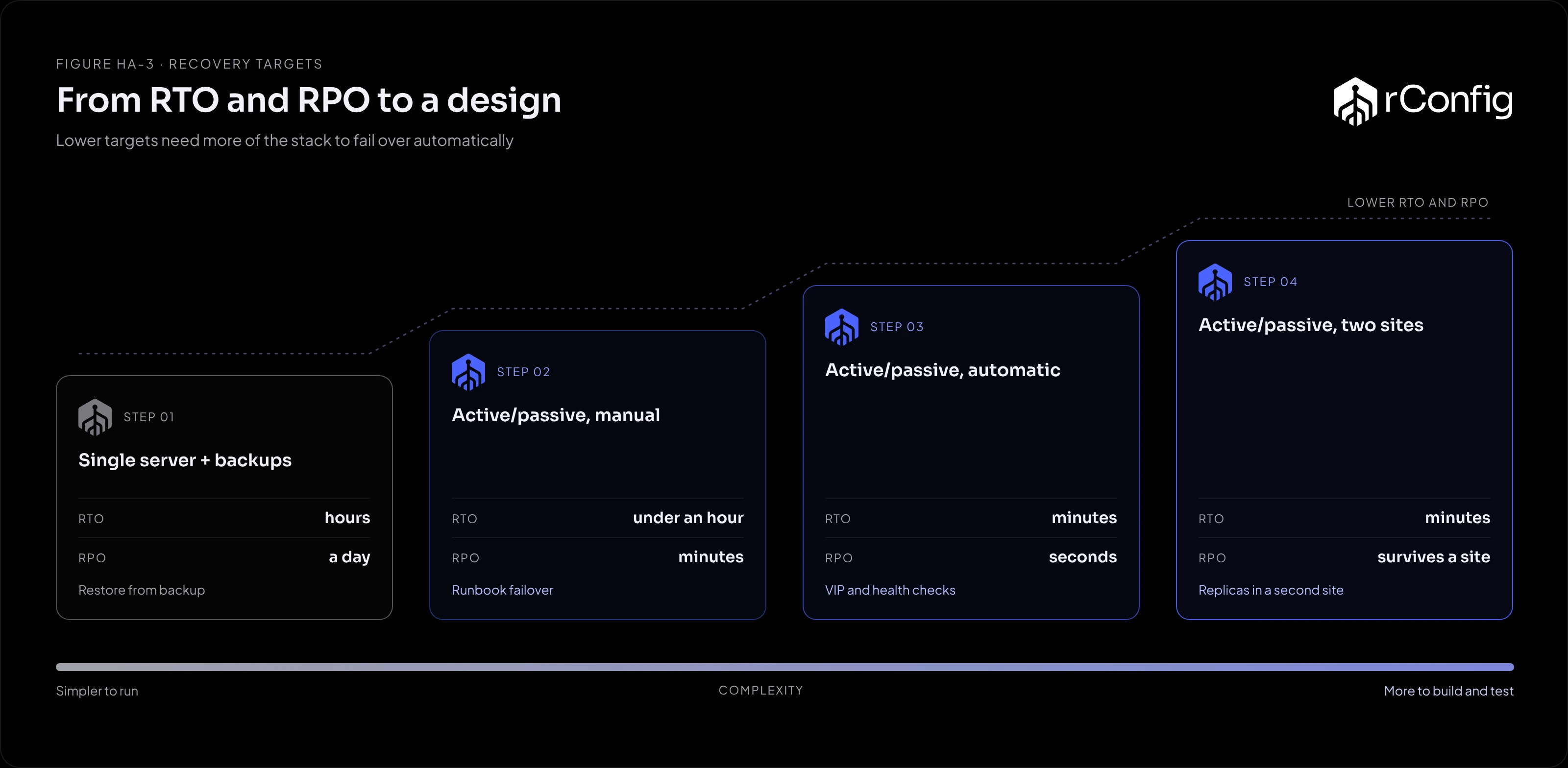
There is no active/active design. See why one node is always passive.
Edition and support
The designs are the same for every edition; the support is not. Enterprise and Vector customers can design the deployment with rConfig and get direct support for the HA layer. Pro customers build and run the HA layer themselves, and rConfig supports the application on it. PostgreSQL is available on Enterprise; Pro deployments use MySQL or MariaDB.