

Why one rConfig node is always passive
Most web applications scale out by adding nodes behind a load balancer: each request goes to whichever node is free. rConfig can’t work that way, and every HA design in these guides follows from why. This page explains the reason and what it means for load balancers, the scheduler, queue workers and failover.
rConfig’s real work is outbound
A user clicking through the web interface is a small part of what rConfig does. Most of its work goes the other way: rConfig opens sessions to your devices.
- The scheduler starts every minute and queues the scheduled tasks that are due: backups, compliance reports, purges.
- Horizon queue workers pick those jobs up and open SSH, Telnet, API or TL1 sessions to devices, collect configs, run compliance checks and send snippets.
- Manual actions (download now, send snippet) queue jobs the same way.
The nodes don’t divide this work between them. There’s no cluster membership, no shared lock that hands each device to one node, and no coordination of outbound sessions. Each node that runs a scheduler queues every due task, and each node that runs workers takes jobs from the queue.
What two active nodes would do
| If both nodes ran… | What happens |
|---|---|
| The scheduler | Every scheduled task is queued twice. Every device is backed up twice, every report runs twice |
| Queue workers | Two nodes connect to the same devices at the same time, doubling the load on devices and on AAA servers, and racing to store the same config |
| The web interface behind round-robin | Users bounce between nodes, losing their session and seeing actions start on whichever node they landed on |
Devices with limits on concurrent management sessions start refusing connections. Change detection sees the same change twice. None of it is a fault in either node; it’s two nodes each doing the whole job.
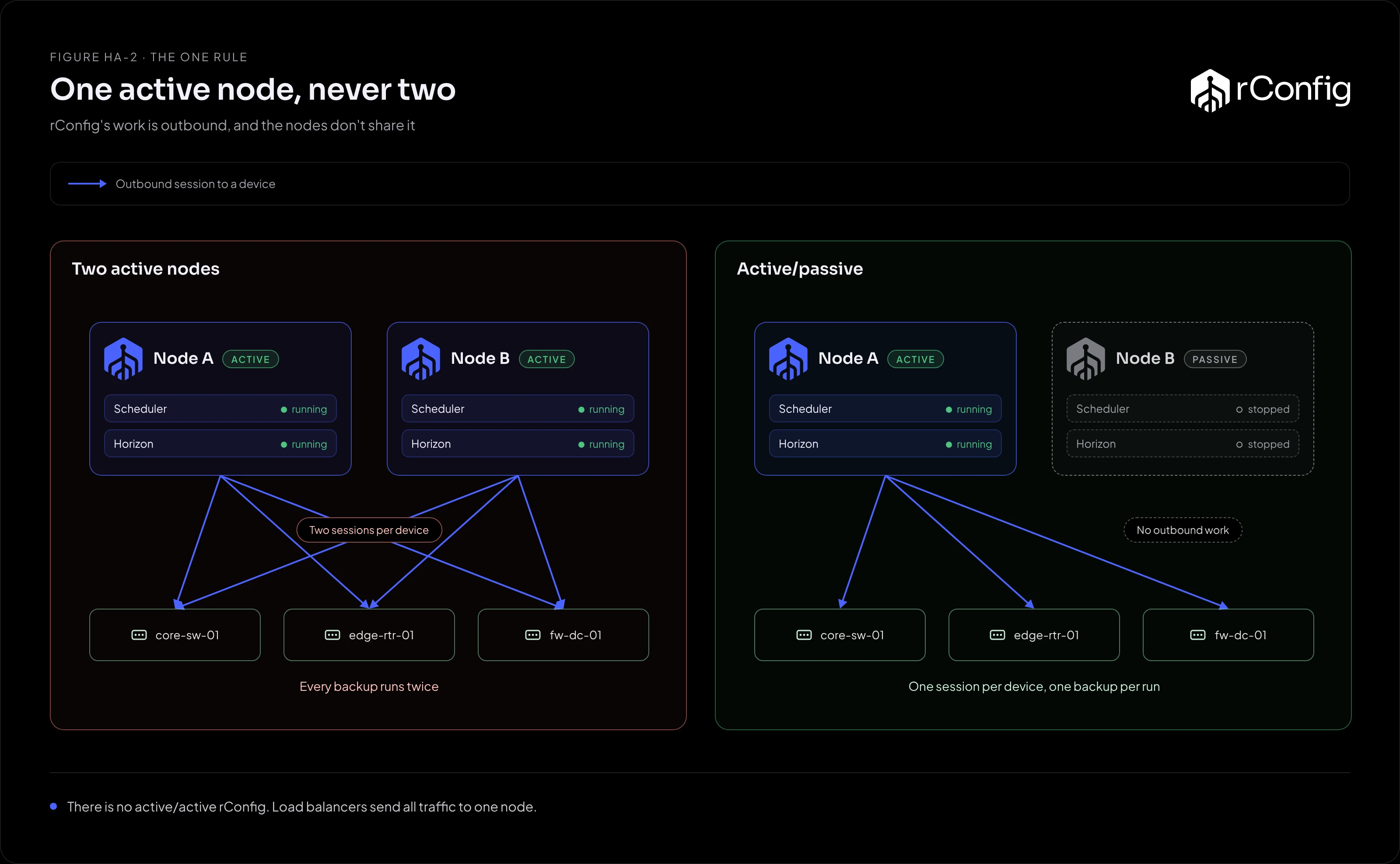
So, in every design
- Exactly one node is active. It serves the web interface and API, runs the scheduler, and runs the Horizon workers.
- The passive node runs nothing that does work. Its web server, cron entry for the scheduler and Horizon (under Supervisor) are stopped. It holds the same release, the same
.envand keys, and access to the same data. - Failover moves the VIP and starts the services together. The node that takes the VIP starts its web server, scheduler and workers; the node that loses it stops them. Wire these together (keepalived notify scripts or Pacemaker resources) so they can’t drift apart.
- Load balancers are allowed, but only active/passive. A load balancer in front of rConfig must send all traffic to the active node and use health checks only to decide which node that is. Never round-robin, least-connections or session-sticky balancing across both.
The rest of the stack can be clustered
The one-active-node rule is about the rConfig application. The components behind it are a different matter, and each has its own HA design:
| Component | Can it run on several nodes at once? |
|---|---|
| rConfig application (and Vector Server, Central Manager, Prism) | No. Active/passive only |
| Database | Yes, with replication; rConfig writes to one primary at a time |
| Redis or Valkey | Yes, with replication and Sentinel; rConfig talks to the primary through a VIP |
| Storage | Yes, shared storage can be clustered, or the active node replicates to the passive node |
| RabbitMQ (Vector Central Manager) | Yes, clustering is supported |
Scaling out instead
If one active node isn’t enough capacity, the answer is more independent rConfig servers, each owning part of the inventory, or Vector’s distributed collection, not more active nodes for the same inventory. Each independent server can itself be an active/passive pair. See choosing an architecture.