

High availability for Vector Server, Central Manager and Prism
The rConfig V8 Vector Server, Vector Central Manager and Vector Prism are built on the same platform as rConfig itself. Each one is made highly available the same way: an active/passive pair behind a VIP, with a replicated database, Redis or Valkey failover, and shared or replicated storage. This page covers what’s specific to Vector: which components matter most, RabbitMQ between the Central Manager and its servers, and what agents do during a failover.
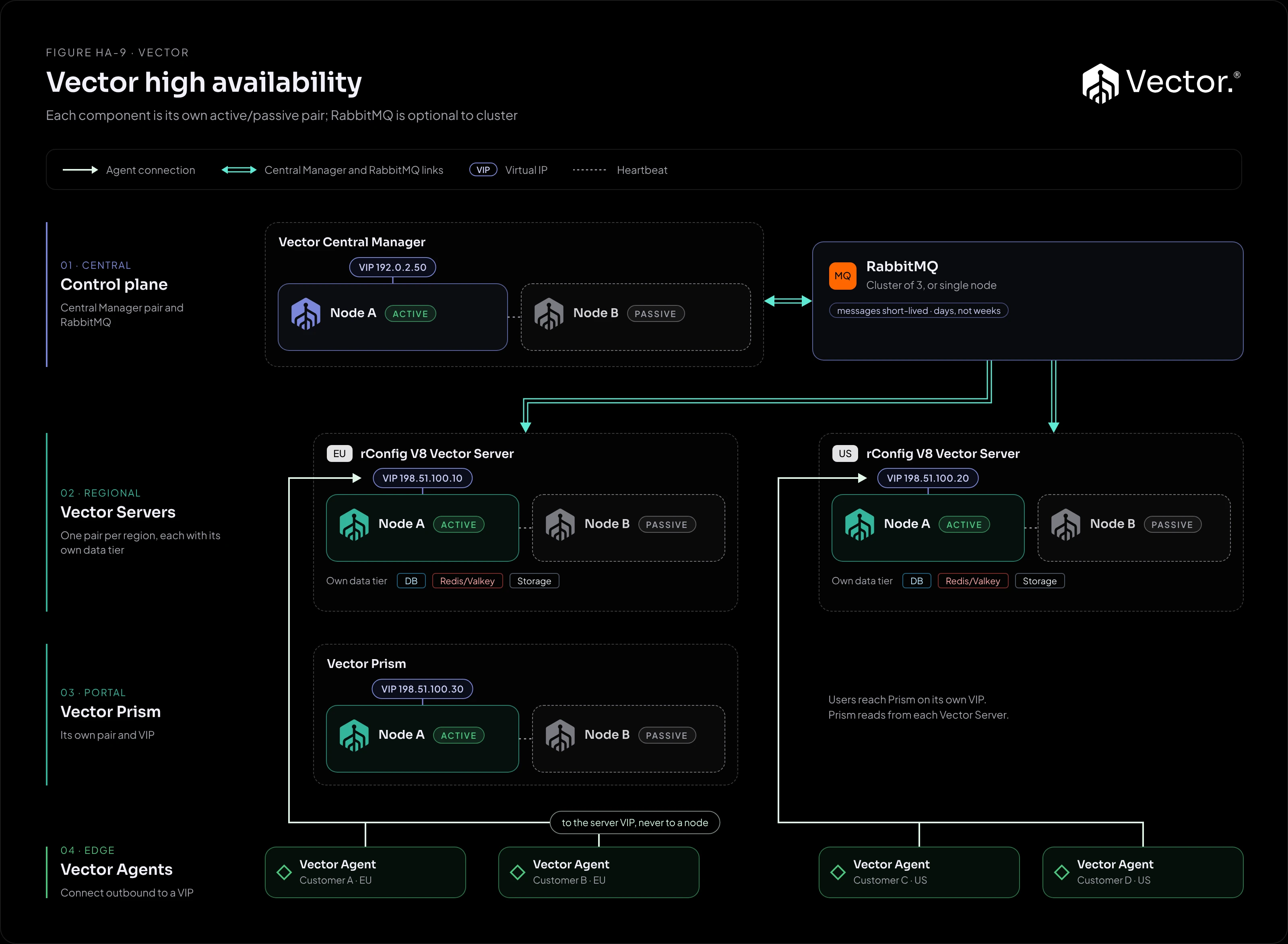
Each component is its own active/passive pair
| Component | What it does | If it’s down | HA design |
|---|---|---|---|
| Vector Server | Stores and processes configs collected by its agents; runs schedules and compliance | Its agents can’t deliver configs and no schedules run for its devices | Active/passive pair |
| Vector Central Manager | Orchestrates inventory across several Vector Servers | Changes made centrally don’t reach the servers; each server keeps collecting on its own | Active/passive pair, plus RabbitMQ (below) |
| Vector Prism | Read-only customer portal over a Vector deployment | Customers can’t see their configs; collection is unaffected | Active/passive pair, or a tested rebuild if the portal’s RTO allows |
| Vector agents | Collect configs close to the devices | That site’s devices aren’t collected | A replacement agent, or a second agent where the site justifies it |
The one-active-node rule applies to every one of them, for the same reason as rConfig: they do scheduled, outbound work that the nodes don’t share. See why one node is always passive.
Put the effort where an outage costs most. The Vector Server is usually the priority, because it’s where collection stops. The Central Manager and Prism can often accept a longer RTO.
RabbitMQ is different
RabbitMQ carries messages between the Central Manager and its Vector Servers. It’s the one component in a Vector deployment that isn’t built on the rConfig platform, and it behaves differently:
- It holds little that matters for long. Messages are processed shortly after they arrive. Stored messages and their audit trail are rarely needed beyond a few days.
- It doesn’t hold configurations. Each Vector Server stores its own devices’ configs. A RabbitMQ outage delays messages between the Central Manager and its servers; it doesn’t lose backups.
- Clustering is supported, for deployments whose targets need RabbitMQ to keep running through a node failure.
So there are two sound choices:
| Choice | When it fits |
|---|---|
| A RabbitMQ cluster (three nodes) | The Central Manager’s RTO is short, and messages must keep flowing through a node failure |
| A single RabbitMQ node, monitored, with a tested rebuild | A delay of a rebuild’s length in central changes is acceptable |
Either way, keep message retention short. There’s no need to keep messages for weeks for rConfig’s sake. See Message Queuing with Vector CM.
Agents during a failover
Agents connect to their Vector Server’s address. Make that address the server pair’s VIP:
- During failover, agents lose their connection and reconnect when the VIP moves to the passive node.
- Schedules that fell inside the outage run at their next interval.
- Never point agents at one node’s own address. After failover they’d keep trying the failed node.
For agents connecting over the internet, the VIP (or the load balancer in front of the pair) is the address published in DNS and in the agents’ configuration.
HA across the Vector architectures
Each Vector architecture adds HA in the same places:
| Architecture | Make highly available first | Then |
|---|---|---|
| Single server | The Vector Server | Agents at the most important customer sites |
| Multi-country | Each country’s Vector Server | The Central Manager and RabbitMQ |
| Access nodes | The Vector Server | The shared access nodes, which carry many customers’ agents |
| Prism | The Vector Server | Prism, if customers rely on it continuously |
| ISP PoP | The Vector Server in the NOC | Agents in the largest PoPs |
| Security zones | The Vector Server | Agents in zones where collection gaps matter most (PCI, OT) |