

Valkey high availability for rConfig
Valkey replaces Redis on Rocky Linux, CentOS Stream and RHEL 10. It is Redis-compatible, runs on port 6379, and rConfig uses it exactly as it uses Redis, with no .env changes. Its HA design is the same as for Redis: Valkey replication, Valkey Sentinel, and a VIP that follows the primary. This page covers what differs in practice.
The design
| Part | What it does |
|---|---|
| Valkey primary and replica (two or more nodes) | The primary takes writes; replicas copy it continuously |
| Valkey Sentinel (three instances) | Agrees by majority that the primary has failed, promotes a replica and repoints the others |
| VIP | Held by the current primary. rConfig’s REDIS_HOST is the VIP |
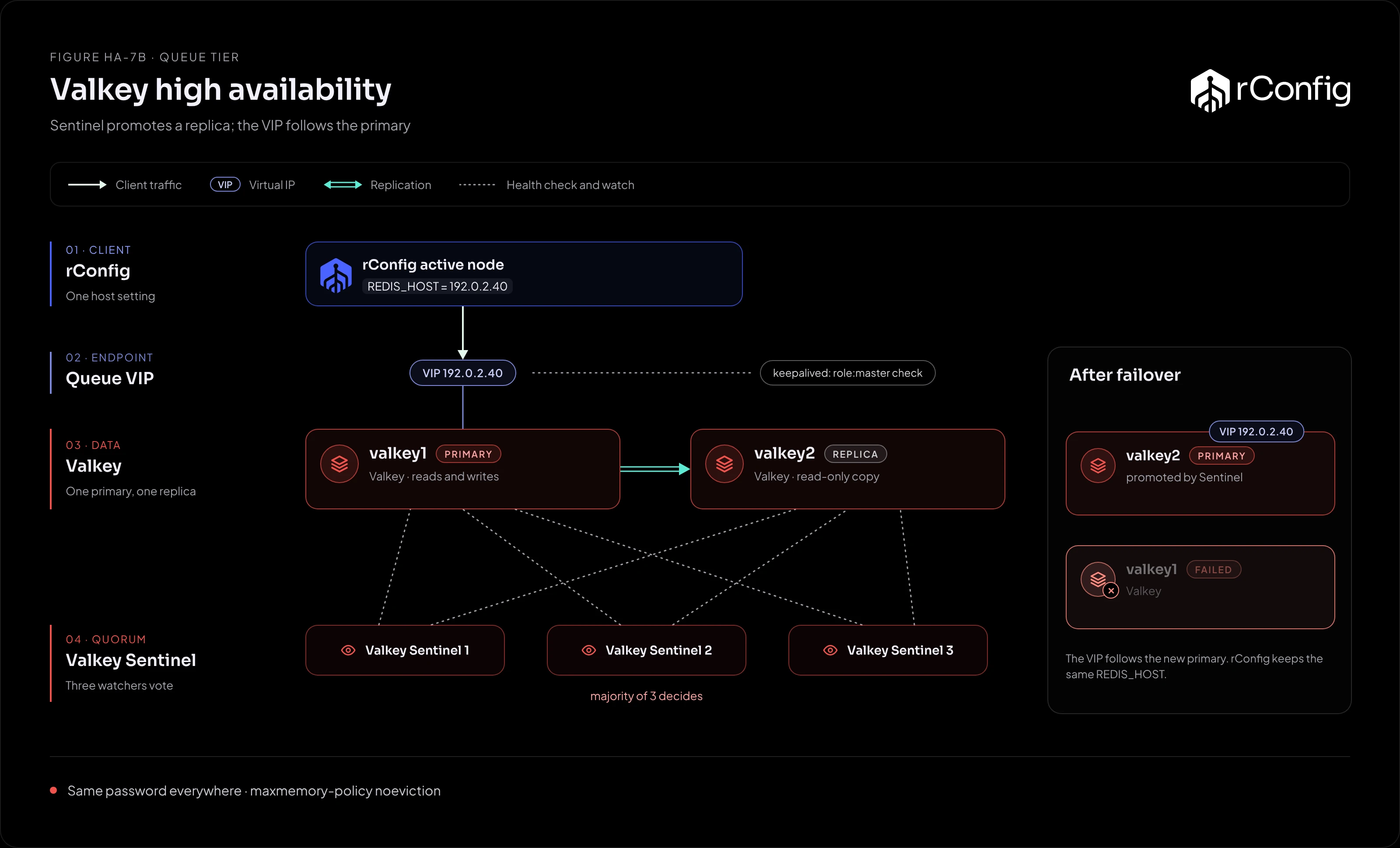
Everything on the Redis page applies: one shared password, noeviction, three Sentinels on separate hosts, and a VIP that follows the primary.
What’s different with Valkey
| Redis | Valkey on EL10 | |
|---|---|---|
| Service | redis |
valkey (and valkey-sentinel) |
| Config file | /etc/redis/redis.conf or /etc/redis.conf |
/etc/valkey/valkey.conf |
| Sentinel config | /etc/redis/sentinel.conf |
/etc/valkey/sentinel.conf |
| CLI | redis-cli |
valkey-cli |
| Replication role reported | role:master |
role:master |
The keepalived check script is the same, using valkey-cli:
#!/bin/bash# Exit 0 only when the local Valkey is the primary. keepalived gives the VIP to that node.REDISCLI_AUTH="$(cat /etc/valkey/rconfig.pass)" \ valkey-cli -h 127.0.0.1 -p 6379 info replication 2>/dev/null | grep -q '^role:master'Check the exact service and file names on your release with systemctl list-unit-files 'valkey*'.
Mixing Redis and Valkey
Keep one technology across the replicated set, so every node, Sentinel and check script uses the same software and tools. When you move a deployment to EL10, build the Valkey nodes as a new replicated set, switch the VIP over in a maintenance window, and retire the Redis nodes.