
Policy Assignments
Policy Assignments: Linking Compliance Rules to Network Devices in rConfig V8 Pro
Section titled “Policy Assignments: Linking Compliance Rules to Network Devices in rConfig V8 Pro”Policy Assignments connect policy definitions to device scopes, creating the link between compliance rules and the devices they evaluate. An assignment specifies which devices to validate (scope), which command output to evaluate (configuration source), and which policy definition to apply (compliance rules). Assignments are the operational layer that transforms abstract policy definitions into concrete compliance validation across your network infrastructure.
See worked examples in the Policy Library.
Understanding how to configure policy assignments correctly ensures compliance checks target the right devices, evaluate the appropriate configurations, and produce meaningful results for remediation and reporting.
Understanding Policy Assignments
Section titled “Understanding Policy Assignments”What Policy Assignments Do
Section titled “What Policy Assignments Do”Link policies to devices: Assignments bridge the gap between policy definitions (rules) and device populations (targets), enabling flexible compliance enforcement across any organizational structure.
Define validation scope: Specify exactly which devices are evaluated: individual devices for granular control, Command Groups for device type grouping, or tags for flexible cross-cutting concerns.
Select configuration source: Choose which command output to validate (e.g., show running-config, show version), ensuring policy rules evaluate relevant configuration data.
Enable selective enforcement: Disable assignments for testing or temporary suspension without deleting configuration, preserving assignment history and simplifying re-activation.
Support multiple policies: A single device can be subject to multiple policy assignments, each validating different aspects of configuration (security baseline, service standards, interface requirements).
Why Assignments Matter
Section titled “Why Assignments Matter”Organizational flexibility: Different device types, locations, or functions require different compliance policies. Assignments enable this flexibility by allowing varied policy application based on device characteristics.
Scalable enforcement: Apply policies to hundreds or thousands of devices through Command Group or tag assignments without configuring individual devices. As network grows, new devices automatically inherit policies based on their Command Group or tag membership.
Testing and validation: Disabled assignments allow testing new policies against device populations without affecting compliance reports, enabling safe policy development workflows.
Audit trails: Assignment history tracks which policies applied to which devices and when, supporting compliance audits and troubleshooting historical compliance issues.
Granular control: Combine multiple assignments to validate different configuration aspects (one for security baseline, another for service standards, a third for interface configurations), providing comprehensive yet organized compliance validation.
Accessing Policy Assignments
Section titled “Accessing Policy Assignments”Navigate to Compliance → Assignments to access the assignment management interface.
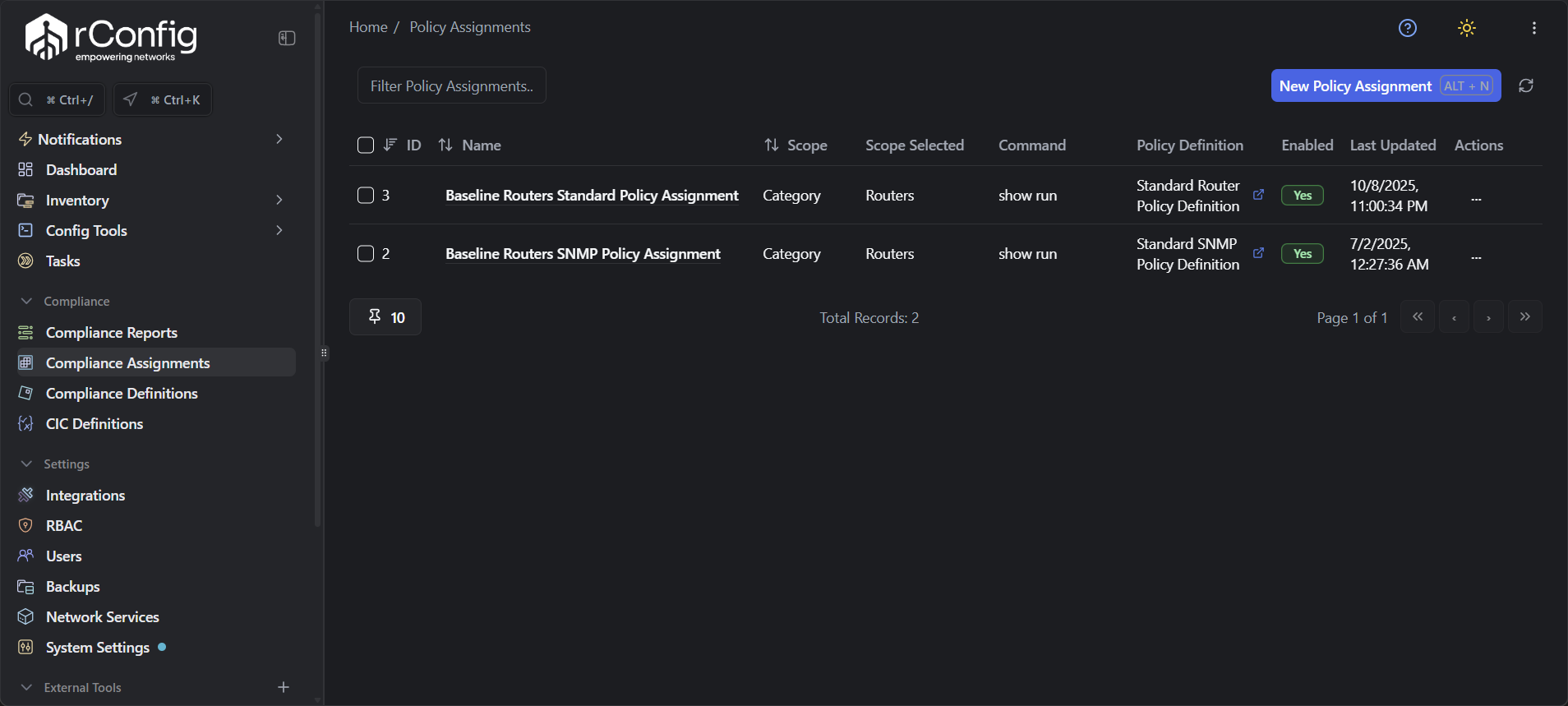 Policy Assignments Main View
Main view displays:
- Assignment name and description
- Scope type (Device, Command Group, Tag) and scope name
- Command output being evaluated
- Policy definition being applied
- Enabled/disabled status
- Last execution timestamp
- Actions menu: Run now, Edit, Delete
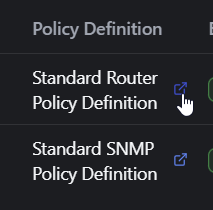
- A link icon beside the policy definition name that opens the definition in a new tab
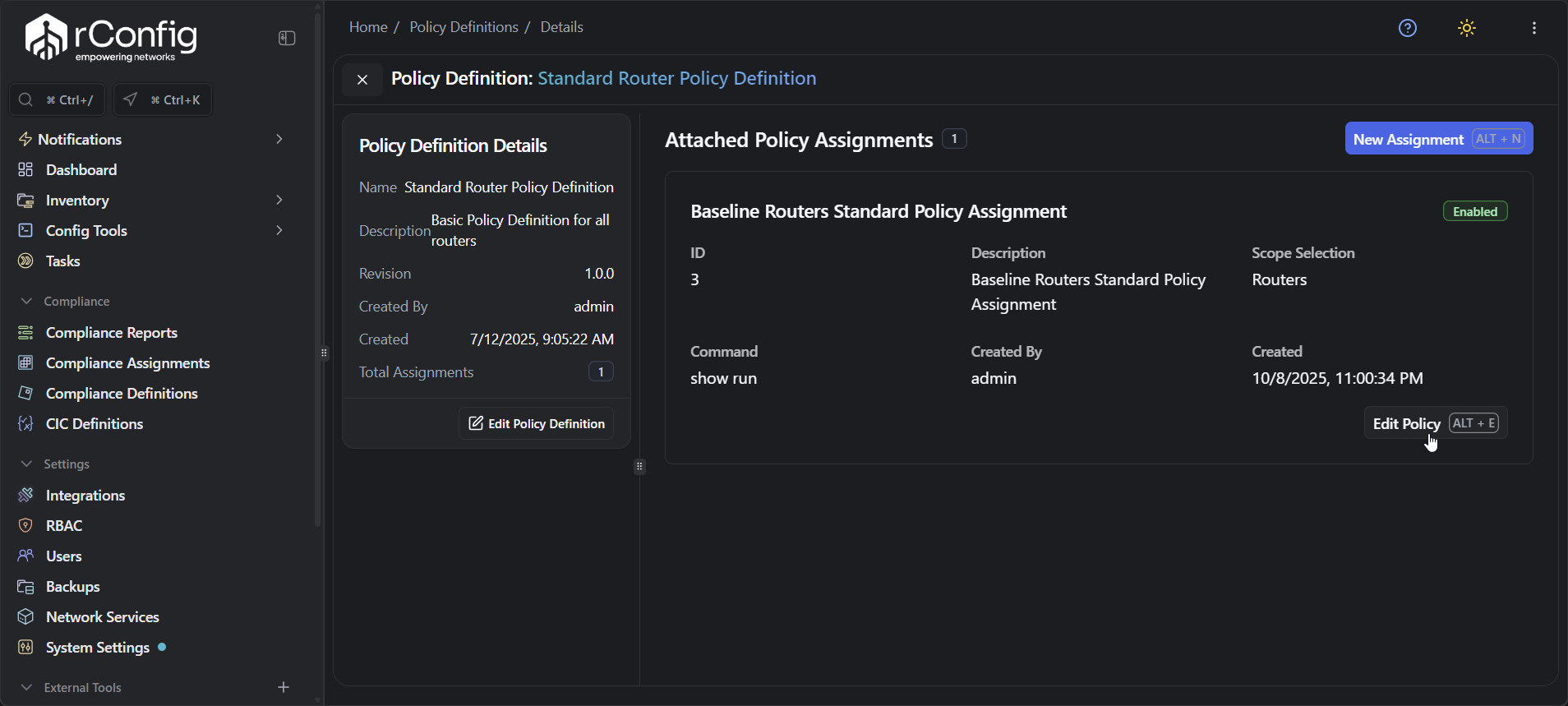 Policy Assignment Expanded View
From V8.2.1 the page header includes a View Smart Groups button (indigo gradient) that links to the Smart Groups management page, alongside an inline help popover. Use it when you need to inspect or edit the underlying Smart Group an assignment targets.
 View Smart Groups header button (V8.2.1+)
Prerequisites
Section titled “Prerequisites”Before creating a Policy Assignment, confirm you have:
- At least one Policy Definition already created with the compliance rules you want to enforce
- The device, Command Group, Tag, or Smart Group you plan to target already exists and contains the devices you expect
- A Command Set that produces the configuration output your policy needs to evaluate (for example
show running-config), and confirmation that it runs successfully during backups - Permission to manage Policy Assignments in your rConfig role
Assignment Configuration Rules
Section titled “Assignment Configuration Rules”Before creating assignments, understand the rules governing assignment configuration:
Rule 1: Single scope per assignment
- Each assignment can target ONE device, ONE Command Group, OR ONE tag
- Cannot assign to multiple scopes simultaneously (e.g., cannot select “Device A AND Command Group B”)
- Create separate assignments for different scopes, even if using same policy definition
Rule 2: Single command per assignment
- Each assignment evaluates one command output per device
- To validate multiple commands, create separate assignments
- Choose command that contains configurations being validated by policy
Rule 3: Single policy definition per assignment
- Each assignment applies one policy definition
- Policy definition can contain multiple rules, but assignment references single definition
- To apply multiple policy definitions to same scope, create multiple assignments
Rule 4: Reusability
- Multiple assignments can use the same policy definition
- Policy definition updates automatically apply to all assignments using that definition
- Single policy can enforce compliance across varied scopes (different Command Groups, tags, devices)
Rule 5: Enabled/Disabled state
- Assignments can be disabled without deletion
- Disabled assignments don’t execute in compliance jobs
- Useful for testing, troubleshooting, or temporary suspension
Creating a Policy Assignment
Section titled “Creating a Policy Assignment”Step 1: Add New Assignment
Section titled “Step 1: Add New Assignment”Click New Policy Assignment to create an assignment.
Step 2: Configure Assignment Name and Description
Section titled “Step 2: Configure Assignment Name and Description”Assignment Name: Descriptive identifier indicating scope, policy, and purpose.
Naming best practices:
- Include scope type and name:
Routers-Security-Baseline - Indicate policy focus:
Core-Switches-NTP-Standard - Use consistent naming conventions:
[Scope]-[PolicyArea]-[Purpose]
Description (optional): Detailed explanation of assignment purpose, why it exists, and any special considerations.
Good naming examples:
Production-Routers-Security-BaselineDMZ-Firewalls-PCI-DSS-RequirementsAccess-Switches-Interface-StandardsAll-Devices-NTP-DNS-Configuration
Poor naming examples:
Assignment1TestPolicy-Check
Step 3: Select Scope
Section titled “Step 3: Select Scope”Choose assignment scope type and specific target.
Scope options:
Device: Single device compliance validation
- Use for: Unique device requirements, testing new policies, troubleshooting specific devices
- Select: Individual device from dropdown
- Example: Critical core router requiring enhanced security validation
Command Group: All devices in the Command Group
- Use for: Device type-specific policies (routers, switches, firewalls), role-based compliance (core, distribution, access)
- Select: Command Group from dropdown (e.g., “Cisco-Routers”, “HP-Switches”)
- Example: All Cisco routers must meet IOS security baseline
Tag: All devices with specific tag
- Use for: Cross-cutting policies (production vs. lab, PCI scope, geographic location), flexible grouping beyond device type
- Select: Tag from dropdown (e.g., “Production”, “PCI-Scope”, “DataCenter-A”)
- Example: All production devices require standard NTP/DNS configuration
Smart Groups (V8.2.1+): All devices currently matching a saved Smart Group rule set
- Use for: Dynamic populations that change as devices are added, retired, or relabelled (e.g., “all Cisco IOS routers running version 15.x”, “all devices imported from Netbox tagged production”)
- Select: Smart Group from dropdown
- Example: A Smart Group named
Edge-Routers-IOS-15automatically picks up new edge routers as they are imported, without you editing the assignment
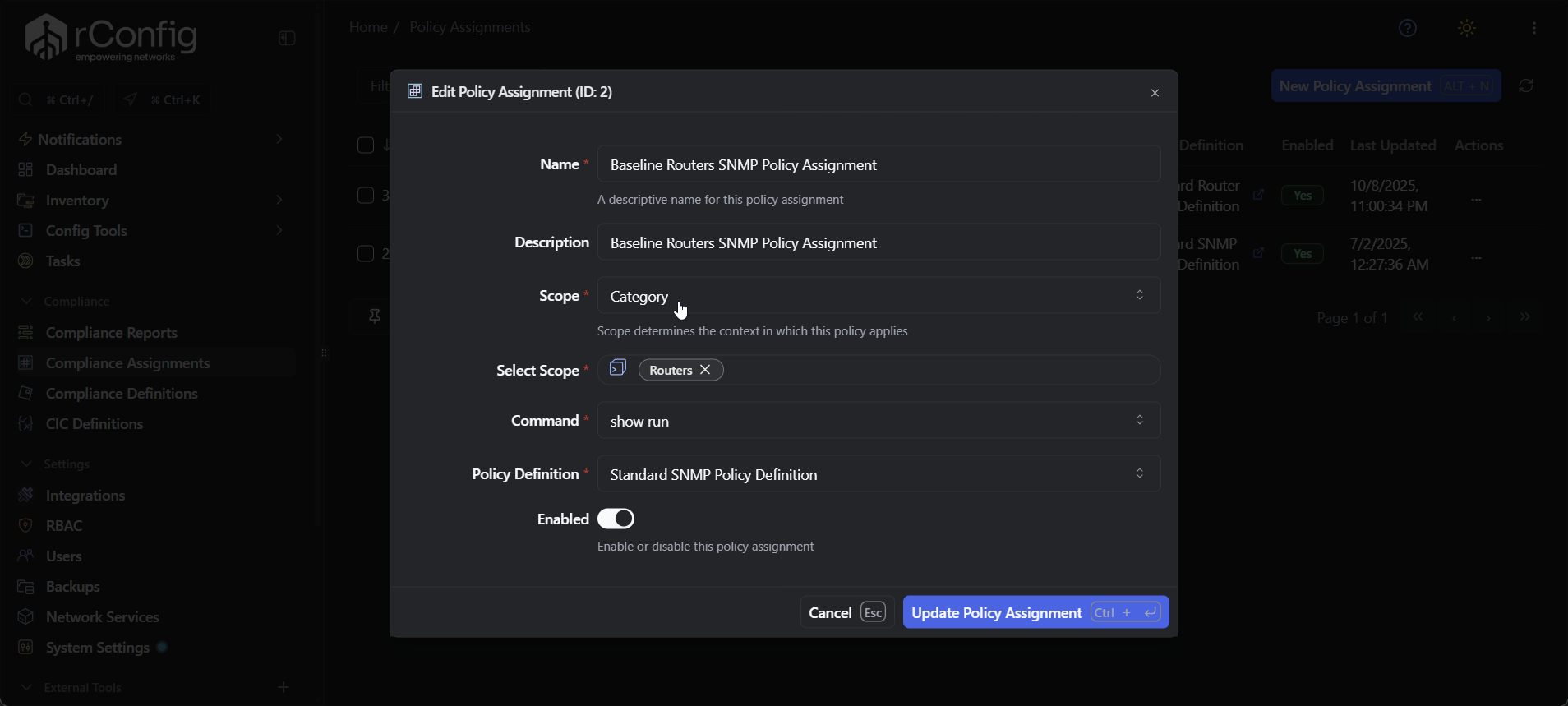 Assignment Scope Selection
The V8.2.1 scope picker uses a single-row layout: pick the Type, then the Target, then the Command. The Command list is filtered by the target’s Command Group so you can only pick commands that exist for that scope.
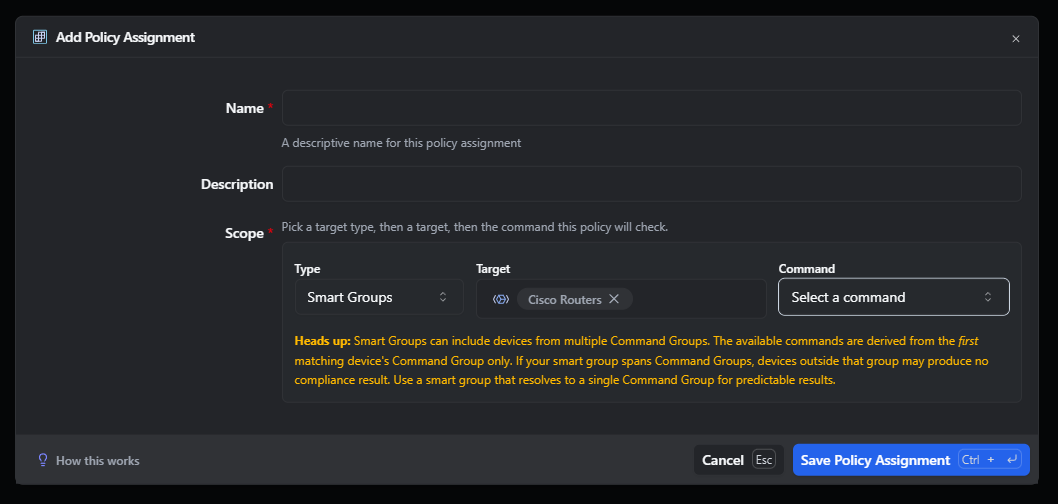 Smart Groups scope with the homogeneity caveat (V8.2.1+)
Step 4: Select Command Output
Section titled “Step 4: Select Command Output”Choose which command output to evaluate against policy rules.
Command selection guidelines:
Match policy to command: Choose command whose output contains configurations validated by policy definition.
- Validating NTP servers? Use
show running-config - Validating software version? Use
show version - Validating interface status? Use
show ip interface brief
Avoid mismatches: Don’t select show version to validate SNMP configuration, since those configs don’t appear in version output.
Consider output size: Smaller, targeted command outputs process faster than large dumps like show tech-support.
Verify command execution: Ensure selected command exists in device command groups and executes successfully during backups.
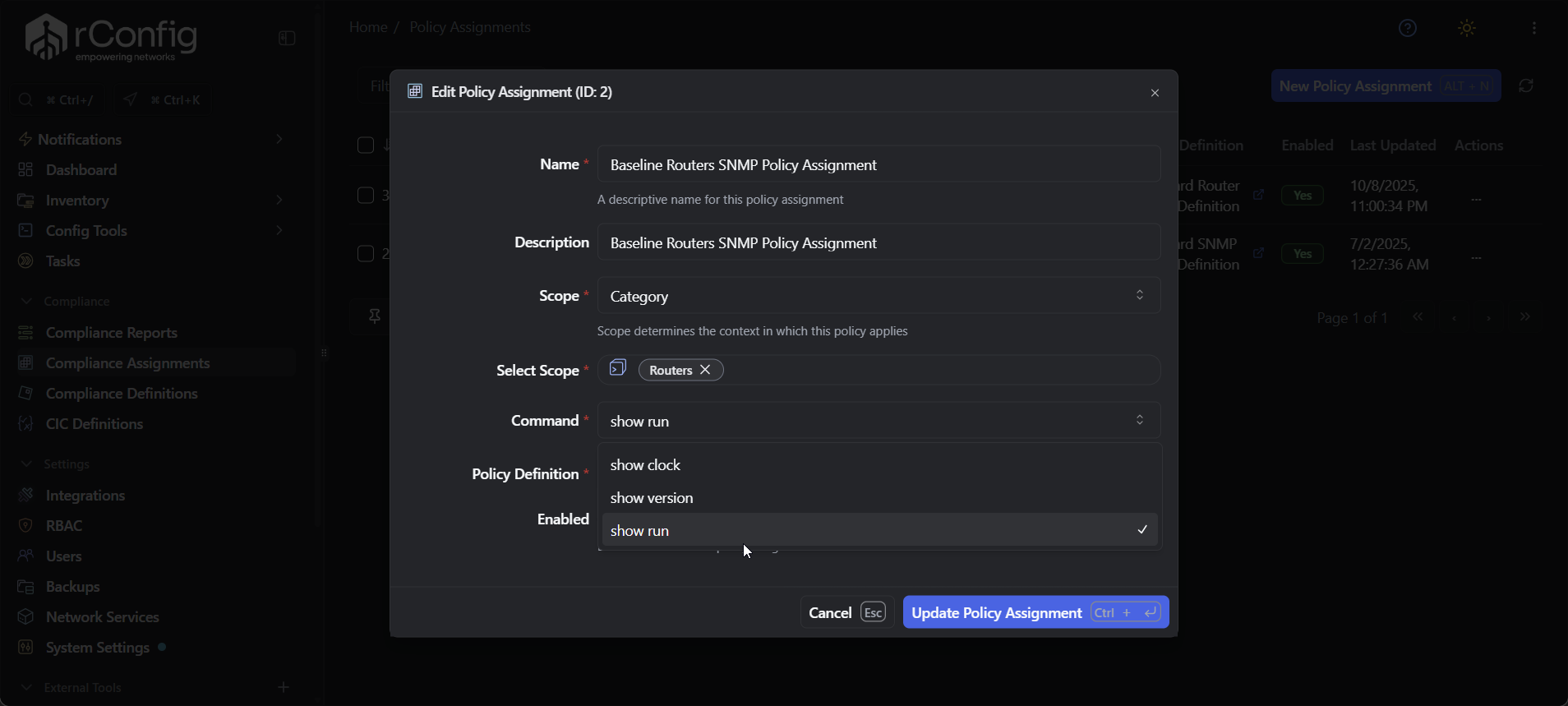 Command Selection
Common command choices:
| Policy Validates | Appropriate Command |
|---|---|
| Running configuration elements | show running-config |
| Startup configuration | show startup-config |
| Software version | show version |
| Interface configurations | show running-config |
| Routing protocols | show running-config |
| SNMP settings | show running-config |
| AAA configuration | show running-config |
Step 5: Select Policy Definition
Section titled “Step 5: Select Policy Definition”Choose which policy definition contains compliance rules for this assignment.
Policy definition selection:
- Dropdown lists all available policy definitions
- Definitions display name and brief description
- Preview policy content if needed before selecting
- Can change policy definition later if requirements change
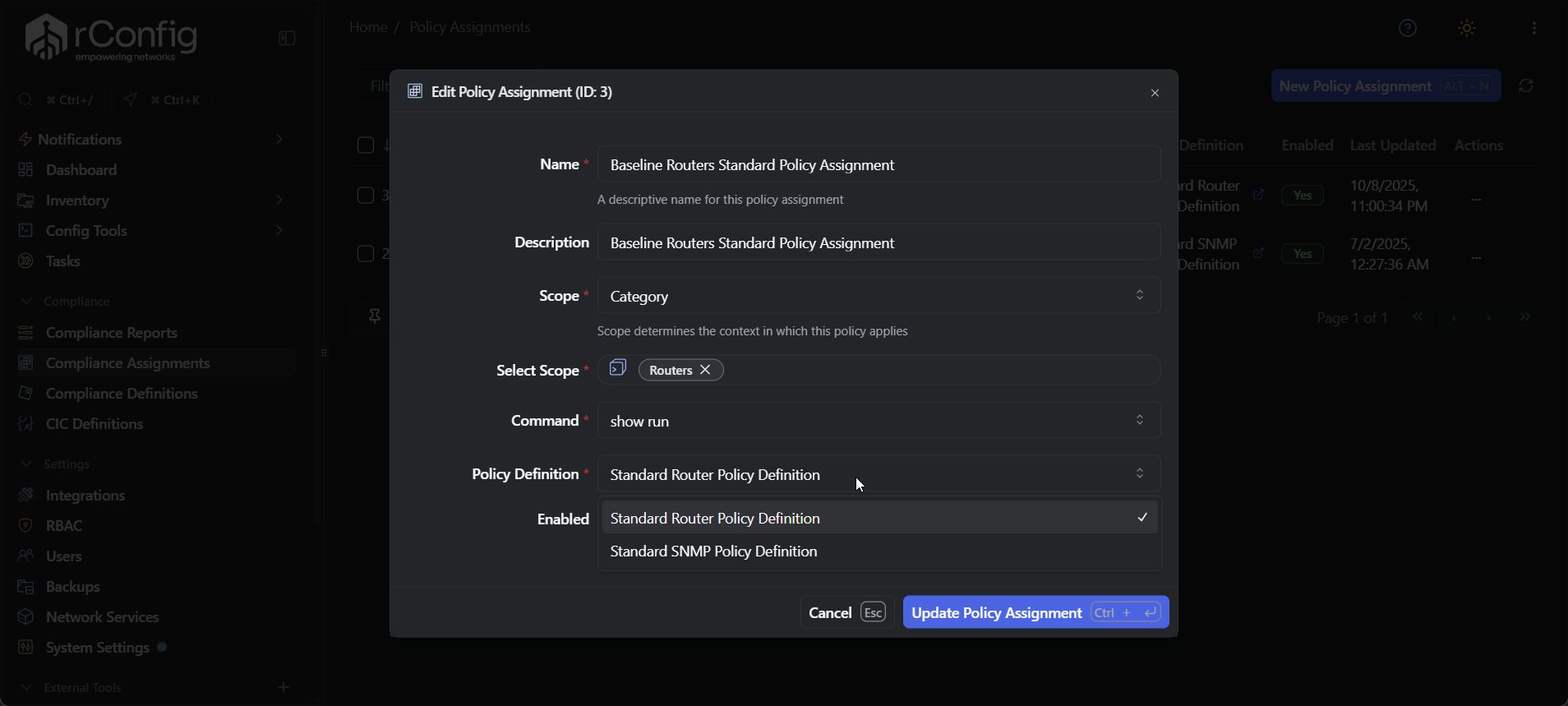 Policy Definition Selection
Selection considerations:
Policy-scope alignment: Ensure policy rules are relevant to device scope.
- Don’t assign Cisco IOS-specific policies to Juniper devices
- Don’t assign firewall policies to switches
- Match policy complexity to device capability
Command compatibility: Verify policy rules evaluate configurations present in selected command output.
- Policy checking interface configs? Command must output interface configurations
- Policy validating SNMP? Command must include SNMP configuration
Testing first: For new or modified policies, consider testing on small scope (single device or small Command Group) before broad deployment.
Step 6: Set Enabled Status
Section titled “Step 6: Set Enabled Status”Enabled: Assignment executes in compliance jobs, results appear in reports.
Disabled: Assignment exists in configuration but doesn’t execute. Results don’t appear in current compliance reports (historical results remain).
When to disable:
- Testing new policy definitions without affecting production reports
- Troubleshooting policy issues on specific device groups
- Temporarily suspending compliance validation during maintenance
- Preparing assignments for future activation
When to enable:
- Policy definition tested and validated
- Ready for production compliance enforcement
- Devices in scope are backing up successfully
- Command output contains required configuration data
Step 6.5: Set Run on Backup (V8.2.1+)
Section titled “Step 6.5: Set Run on Backup (V8.2.1+)”The Run on backup toggle controls whether this assignment evaluates automatically after each successful device backup.
- On (default): After any device in scope finishes a successful backup, rConfig dispatches a per-device compliance check for this assignment. The result appears in the device’s Compliance tab and in the Reports list with a description starting
Auto - post-backup for device …. No report email is sent for these auto runs. - Off: The assignment only runs when triggered manually from the Policy Assignments page actions menu, by a Scheduled Task, or by clicking Re-run compliance on the device’s Compliance tab.
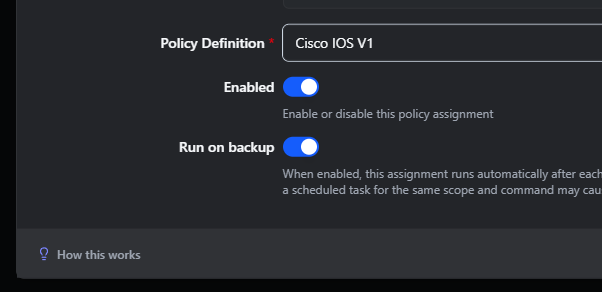 Run on backup toggle (V8.2.1+)
When to leave it on: most production assignments where you want continuous, low-effort compliance feedback per device.
When to turn it off:
- High-cardinality categories where every backup would dispatch dozens of compliance jobs.
- Assignments still being authored or tuned (run them manually until stable, then turn this on).
- Policies where evaluating against partial or historical configs is not useful.
Step 7: Save Assignment
Section titled “Step 7: Save Assignment”Click Save Policy Assignment to create the assignment (the button reads Update Policy Assignment when editing).
Post-creation steps:
- Verify assignment appears in Policy Assignments list
- Confirm scope, command, and policy definition are correct
- If enabled, run manual compliance check to validate configuration
- Review results and adjust if needed
- Create Scheduled Task for automated compliance checking (optional)
Managing Policy Assignments
Section titled “Managing Policy Assignments”Viewing Assignments
Section titled “Viewing Assignments”Main view: Lists all policy assignments with summary information and status indicators.
Row actions: Open the actions menu on any assignment:
- Run now: Runs the assignment immediately
- Edit: Opens the assignment editor
- Delete: Removes the assignment
Editing Assignments
Section titled “Editing Assignments”Click Edit in the assignment’s actions menu to modify it.
Editable elements:
- Assignment name and description
- Scope (can change scope type or target)
- Command output selection
- Policy definition
- Enabled/disabled status
Edit considerations:
Scope changes: Changing scope (e.g., from Command Group A to Command Group B) immediately affects which devices are evaluated. Existing compliance results for old scope remain in history but new jobs evaluate new scope.
Command changes: Changing command output may cause policy failures if policy rules don’t match new command’s output format. Verify policy compatibility before changing commands.
Policy definition changes: Changing to different policy definition entirely changes compliance criteria. Consider creating new assignment instead of modifying existing one if tracking different compliance aspects.
Testing after changes: After significant edits, run manual compliance check to verify assignment works as expected before relying on scheduled execution.
Viewing Policy Definition from Assignment
Section titled “Viewing Policy Definition from Assignment”In the assignments list, click the link icon beside the policy definition name to open the definition being applied in a new tab.
View capabilities:
- Read-only display of policy definition content
- See all rule blocks and validation methods
- Understand exactly what is being validated
- Identify potential policy issues affecting compliance results
Edit from the Definitions page: To modify the policy definition, go to Compliance → Definitions and edit it there. Changes apply to all assignments using that definition.
Viewing Compliance Results
Section titled “Viewing Compliance Results”Go to Compliance → Reports and click View Details or Latest Results in the actions menu of this assignment’s report row.
Results page shows:
- Per-device compliance status (PASS/FAIL)
- Individual rule results
- Last evaluation timestamp
- Detailed failure information for remediation
See Policy Compliance Results for complete guide to interpreting and acting on compliance results.
Deleting Assignments
Section titled “Deleting Assignments”Delete assignments that are no longer needed or were created for testing.
Before deleting:
- Verify assignment is not needed for compliance tracking
- Consider disabling instead of deleting if might be needed later
- Export compliance history if needed for audit purposes
- Document reason for deletion
Deletion impact:
- Assignment configuration is permanently removed
- Historical compliance results remain accessible in database (subject to retention policies)
- Scheduled tasks referencing this assignment will fail; remove or update scheduled tasks first
Assignment Strategies
Section titled “Assignment Strategies”Device-Level Assignments
Section titled “Device-Level Assignments”When to use:
- Testing new policies before broad deployment
- Special compliance requirements for specific devices
- Troubleshooting policy issues on individual devices
- One-off validation scenarios
Example scenarios:
- Test new security baseline on single router before applying to all routers
- Critical device has unique compliance requirements not shared by others
- Validate policy works correctly before scaling to Command Group or tag
Advantages:
- Granular control and minimal impact
- Easy troubleshooting with single device
- Low risk for testing
Disadvantages:
- Doesn’t scale: manual assignment per device
- Difficult to maintain as network grows
- Devices don’t automatically inherit policies
Command Group-Based Assignments
Section titled “Command Group-Based Assignments”When to use:
- Device type-specific compliance (all routers, all switches, all firewalls)
- Vendor-specific policies (Cisco IOS requirements, Juniper JUNOS standards)
- Role-based compliance (core layer, distribution layer, access layer)
Example scenarios:
- All Cisco routers must meet IOS security baseline
- All HP switches require specific SNMP configuration
- All firewalls must comply with security policy framework
Advantages:
- Automatic inheritance: devices in a Command Group automatically inherit policies
- Scales well with network growth
- Logical organization by device type or role
- Easy to understand and maintain
Disadvantages:
- Requires well-maintained device categories
- Less flexible than tags for cross-cutting concerns
- Device can only be in one Command Group
Tag-Based Assignments
Section titled “Tag-Based Assignments”When to use:
- Cross-cutting compliance requirements (production vs. lab, PCI scope, geographic location)
- Flexible grouping beyond device type (critical infrastructure, internet-facing, management network)
- Temporary or project-based compliance tracking
Example scenarios:
- All production devices require standard NTP/DNS regardless of type
- Devices in PCI scope require specific security configurations
- Devices in DataCenter-A have different DNS servers than DataCenter-B
Advantages:
- Maximum flexibility: devices can have multiple tags
- Cross-cutting policies span device types
- Easy to add/remove devices from compliance scope
- Support temporary groupings for projects
Disadvantages:
- Requires disciplined tag management
- Can become complex with many overlapping tags
- Less intuitive than Command Group-based organization
Smart Group Assignments (V8.2.1+)
Section titled “Smart Group Assignments (V8.2.1+)”Best for: Dynamic device populations whose membership changes as devices are imported, retired, or relabelled.
Common patterns:
- Vendor + version: “Cisco IOS routers running 15.x” (Smart Group rules: vendor = Cisco AND model contains IOS AND version starts with 15)
- Status + tag: “Active devices tagged Production” (Smart Group rules: status = active AND tag includes Production)
- Imported set: “Devices originating from Netbox in the DMZ site” (Smart Group rules: origin_system = netbox AND custom property site = DMZ)
Why use them over Tags: Tags are static labels you set per device; Smart Groups are saved filters that re-evaluate at compliance time. New devices that match the rules join automatically and old ones drop out, no per-assignment edits required.
Caveat: Keep the Smart Group homogeneous so its devices share a Command Group. The first matching device’s Command Group sets the available command list, so heterogeneous Smart Groups either need to be split or use a command name that exists across all members’ Command Groups. See the Smart Groups page for the underlying primitive.
Multi-Assignment Strategies
Section titled “Multi-Assignment Strategies”Layered compliance: Use multiple assignments to validate different aspects of device configuration.
Example layered approach:
Device: Core-Router-01├── Assignment 1: Security-Baseline (Command Group: Routers)│ └── Validates: Enable secret, SSH, AAA, no Telnet├── Assignment 2: Standard-Services (Tag: Production)│ └── Validates: NTP, DNS, SNMP, Logging├── Assignment 3: Interface-Standards (Command Group: Routers)│ └── Validates: Interface descriptions, no shutdown└── Assignment 4: PCI-DSS-Requirements (Tag: PCI-Scope) └── Validates: Encryption, access controls, loggingBenefits of layered approach:
- Modular policies easier to maintain
- Clearer reporting: failures isolated to specific compliance area
- Flexible policy application: apply some policies broadly, others selectively
- Testing simplified: disable specific layer without affecting others
Assignment Best Practices
Section titled “Assignment Best Practices”Naming Conventions
Section titled “Naming Conventions”Use consistent, descriptive names: Establish and follow naming conventions across all assignments.
Recommended format: [Scope]-[PolicyArea]-[Purpose]
Examples:
Routers-Security-BaselineProduction-Devices-Standard-ServicesPCI-Scope-Security-RequirementsCore-Switches-Interface-Standards
Include:
- Scope type/name for context
- Policy focus for quick identification
- Purpose or compliance area
Avoid:
- Generic names:
Policy1,Assignment-Test - Unclear abbreviations:
Prod-SW-Cfg-1 - Inconsistent formats across assignments
Documentation
Section titled “Documentation”Use description field: Always provide detailed descriptions explaining:
- Why assignment exists
- What compliance it enforces
- Any exceptions or special considerations
- Related tickets, change requests, or audit requirements
Example description:
Enforces PCI-DSS security baseline requirements for all devicesin cardholder data environment. Validates encryption, accesscontrols, and logging as required by PCI-DSS v3.2.1 sections2.2, 2.3, and 8.1. Created per ticket SEC-2024-156.Testing Before Production
Section titled “Testing Before Production”Always test new assignments:
- Create assignment with status Disabled
- Test manually on single device or small group
- Review results and adjust policy or assignment if needed
- Enable assignment for production enforcement
- Monitor initial results for unexpected failures
Incremental rollout:
- Start with device-level assignment for testing
- Expand to small Command Group or tag
- Validate results across broader scope
- Finally apply to full production population
Scope Management
Section titled “Scope Management”Keep scopes organized:
- Maintain clean Command Group structure
- Use tags consistently across devices
- Document tag purposes and usage
- Regularly audit device categorization and tagging
Avoid scope overlap confusion:
- If device is in multiple scopes with same policy, it will be evaluated multiple times (not harmful but inefficient)
- Use layered approach with different policies for each scope rather than duplicating policies
Command Selection
Section titled “Command Selection”Verify command availability:
- Ensure command exists in device command groups
- Confirm command executes successfully during backups
- Check command output contains configurations policy evaluates
Use appropriate command granularity:
- Prefer specific commands over large dumps
show running-configfor most configuration validationsshow versionfor version/hardware validation- Targeted commands for specific feature validation
Maintenance and Review
Section titled “Maintenance and Review”Regular review cycle:
- Monthly: Review assignment enabled/disabled status
- Quarterly: Validate assignments still align with compliance requirements
- After major changes: Review affected assignments for continued relevance
- Audit period: Verify assignments meet current regulatory requirements
Clean up obsolete assignments:
- Delete or disable assignments no longer needed
- Archive historical compliance data if required
- Document reasons for assignment removal
Troubleshooting Assignments
Section titled “Troubleshooting Assignments”Assignment Not Executing
Section titled “Assignment Not Executing”Symptoms: Compliance results don’t appear for assignment despite enabled status.
Possible causes:
- Assignment disabled: Verify enabled status in assignment configuration
- No devices in scope: Command Group or tag has no assigned devices
- Scheduled task not configured: Manual execution required if no scheduled task
- Horizon queue issues: Compliance jobs not processing
Resolution:
- Check assignment enabled status
- Verify devices exist in selected scope (Command Group/tag membership)
- Run manual compliance check to validate assignment
- Review Horizon queue for failed compliance jobs
- Check application logs for assignment-related errors
All Devices Failing Compliance
Section titled “All Devices Failing Compliance”Symptoms: Every device in assignment scope fails compliance, even known-good devices.
Possible causes:
- Policy definition error: Rules don’t match actual device configuration format
- Wrong command selected: Command output doesn’t contain configurations policy validates
- Case sensitivity issues: Policy strings don’t match device output case
- Configuration not downloaded: Devices missing recent configuration files
Resolution:
- Review policy definition against actual device configuration
- Verify command output contains configurations being validated
- Test policy against known-good device manually
- Check case sensitivity in policy strings
- Ensure devices have recent backup files for selected command
Some Devices Show “NOT EVALUATED - CONFIG NOT FOUND”
Section titled “Some Devices Show “NOT EVALUATED - CONFIG NOT FOUND””Symptoms: Some devices in scope show “NOT EVALUATED” instead of PASS/FAIL.
Cause: Configuration file for selected command doesn’t exist for those devices.
Resolution:
- Verify affected devices are backing up successfully
- Confirm selected command exists in device command groups
- Check backup logs for command execution failures
- Run manual device backup to generate missing configuration files
- Re-run compliance check after successful backups
Assignment Results Inconsistent
Section titled “Assignment Results Inconsistent”Symptoms: Same device shows different results between compliance runs without configuration changes.
Possible causes:
- Policy definition modified: Rules changed between compliance runs
- Configuration actually changed: Device configuration modified between evaluations
- Command output varies: Dynamic content in command output affects evaluation
- Timing issues: Compliance check ran before backup completed
Resolution:
- Review policy definition change history
- Check device configuration history for changes
- Verify policy rules don’t evaluate dynamic content (timestamps, uptime)
- Ensure compliance checks run after backups complete
- Schedule compliance tasks with appropriate delays after backup tasks
Smart Group Assignment Shows Fewer Commands than Expected (V8.2.1+)
Section titled “Smart Group Assignment Shows Fewer Commands than Expected (V8.2.1+)”Symptoms: When the scope type is Smart Groups, the Command dropdown lists commands from one Command Group only, even though the Smart Group resolves to devices across several Command Groups.
Cause: By design. Available commands are derived from the first matching device’s Command Group. Heterogeneous Smart Groups silently exclude devices outside that group from compliance for the chosen command.
Resolution:
- Tighten the Smart Group rules so it resolves to a single Command Group, or
- Split into multiple assignments, one per Command Group your policy needs to cover.
The amber heads-up note in the assignment dialog flags this when Smart Groups is selected.
Auto Compliance Run Not Producing a Report (V8.2.1+)
Section titled “Auto Compliance Run Not Producing a Report (V8.2.1+)”Symptoms: A device finished a successful backup but no Auto - post-backup report appeared in the Compliance Reports list for the expected assignment.
Possible causes:
- Assignment is disabled.
- Run on backup is off on the assignment.
- The device is no longer in scope of the assignment (Smart Group / Tag / Command Group membership changed).
- The compliance worker on the
PolicyCompliancequeue is not running or is backlogged.
Resolution:
- Re-open the assignment and confirm both Enabled and Run on backup are on.
- Confirm the device still resolves into the assignment’s scope (run the assignment manually and check device coverage).
- Check Horizon for the
PolicyCompliancequeue depth and any failed jobs. - If queues look healthy, click Re-run compliance on the device’s Compliance tab to force a per-device evaluation immediately.
Cannot Delete Assignment
Section titled “Cannot Delete Assignment”Symptoms: Delete operation fails or is blocked.
Cause: Scheduled tasks may reference the assignment.
Resolution:
- Identify scheduled tasks using this assignment
- Delete or update scheduled tasks to remove assignment reference
- Retry assignment deletion
- Alternatively, disable assignment instead of deleting if scheduled tasks need preservation
Related Documentation
Section titled “Related Documentation”- Compliance Overview - Understanding the compliance system architecture
- Policy Definitions - Creating compliance rules
- Policy Compliance Results - Reviewing and acting on compliance reports
- Scheduled Tasks - Automating compliance checks
- Horizon Queue Manager - Monitoring compliance job execution
Quick Reference
Section titled “Quick Reference”Assignment Configuration Rules
Section titled “Assignment Configuration Rules”- One scope per assignment (device, Command Group, OR tag)
- One command per assignment
- One policy definition per assignment
- Multiple assignments can use same policy definition
- Assignments can be disabled for testing
Scope Selection Guide
Section titled “Scope Selection Guide”| Scope Type | Use When | Example |
|---|---|---|
| Device | Single device, testing, unique requirements | Critical core router |
| Command Group | Device type, vendor, or role-based policies | All Cisco routers |
| Tag | Cross-cutting concerns, flexible grouping | All production devices |
Assignment Creation Checklist
Section titled “Assignment Creation Checklist”Troubleshooting Quick Checks
Section titled “Troubleshooting Quick Checks”Summary
Section titled “Summary”Policy Assignments are the operational bridge between policy definitions and device populations, enabling flexible, scalable compliance enforcement across network infrastructure. Proper assignment configuration (selecting appropriate scope, matching commands to policy content, and following best practices) ensures compliance validation produces meaningful, actionable results.
Key Takeaways
Section titled “Key Takeaways”Flexible scoping: Device, Command Group, and tag-based assignments provide granular to broad compliance enforcement, adapting to any organizational structure or compliance requirement.
Command-policy alignment: Selecting command output that contains configurations policy validates is critical to assignment success. Misaligned selections cause false failures or missed validations.
Testing and validation: Always test new assignments on small scopes before production deployment, using disabled status during testing to prevent false compliance reports.
Layered approach: Multiple assignments on same devices validate different compliance aspects, providing comprehensive yet organized compliance coverage without policy definition complexity.
Regular maintenance: Review assignments periodically to ensure continued alignment with compliance requirements, removing obsolete assignments and updating as network evolves.
With properly configured policy assignments linking tested policy definitions to appropriate device scopes and commands, rConfig provides reliable, automated compliance validation that scales from single devices to enterprise networks with thousands of devices.