
How to set up Vector Hub and the agent live channel
Vector Hub and the Live Channel: Vector Access, Agent Restarts, and Instant Job Pickup
Section titled “Vector Hub and the Live Channel: Vector Access, Agent Restarts, and Instant Job Pickup”Vector Hub is an optional service on the rConfig server that gives each enabled Vector Agent a persistent, bidirectional live channel. After reading this page you can install the hub, enable the live channel per agent, restart agents remotely, and fix the common hub problems.
When should I use Vector Hub?
Section titled “When should I use Vector Hub?”Without the hub, Vector Agents only poll the rConfig server on a timer, so the server cannot reach into an agent on demand and new jobs wait for the next poll. Install the hub when you want operators to SSH to remote-site devices without a VPN or jump host, restart agents without logging in to the agent host, or have queued jobs start near-instantly.
The hub is additive. If it is not installed, rConfig and its agents behave exactly as before.
What does the live channel unlock?
Section titled “What does the live channel unlock?”| Capability | What it does |
|---|---|
| Vector Access | Opens a live SSH session to a device, proxied through its agent, with optional session recording. |
| Restart an agent | Restarts an agent from the Hub page over the live channel. |
| Auto job pickup | Nudges an agent to poll the moment a job is queued for it. |
| Self-healing certificates | Restores the server’s hub client certificates automatically if they go missing. |
How does Vector Hub work?
Section titled “How does Vector Hub work?”The hub runs on the rConfig server as the hardened systemd service vector-hub.service, under the dedicated vector-hub user. The binary lives at /usr/local/bin/rconfig/activehub/vector-hub. Agents dial in to the hub over an outbound WebSocket, and once connected the server can push commands to them in real time.
The hub opens three listeners:
| Listener | Default address | Who connects | Transport |
|---|---|---|---|
| Public tunnel | :8443 (all interfaces) | Vector Agents, outbound | WSS (WebSocket over TLS), path /tunnel |
| Control API | 127.0.0.1:8444 (loopback only) | the rConfig Laravel app | HTTPS with mutual TLS (mTLS) |
| Session broker | 127.0.0.1:8445 (loopback only) | the vector:access command | authenticated, loopback only |
flowchart LR
  subgraph Site["Remote site"]
    A[Vector Agent] --> D[Network devices]
  end
  subgraph Server["rConfig server"]
    H["vector-hub.service (:8443 tunnel)"]
    L[rConfig app] -- "mTLS :8444" --> H
    S["php artisan vector:access"] -- ":8445" --> H
  end
  A -- "outbound WSS :8443/tunnel" --> H
Prerequisites
Section titled “Prerequisites”- Vector installed and enabled in rConfig. The Hub navigation item and its settings only appear when Vector is installed. See Vector Server installation.
- At least one Vector Agent registered and enabled. See Adding agents to Vector.
- Root access to the rConfig server. The install script writes a systemd unit and TLS material.
- A TLS certificate and private key on the rConfig server for the public tunnel.
- Egress from each agent site to the rConfig server on TCP
8443.
How do I install Vector Hub?
Section titled “How do I install Vector Hub?”Install from the UI (recommended)
Section titled “Install from the UI (recommended)”-
Click Hub in the left sidebar (route
/hub). -
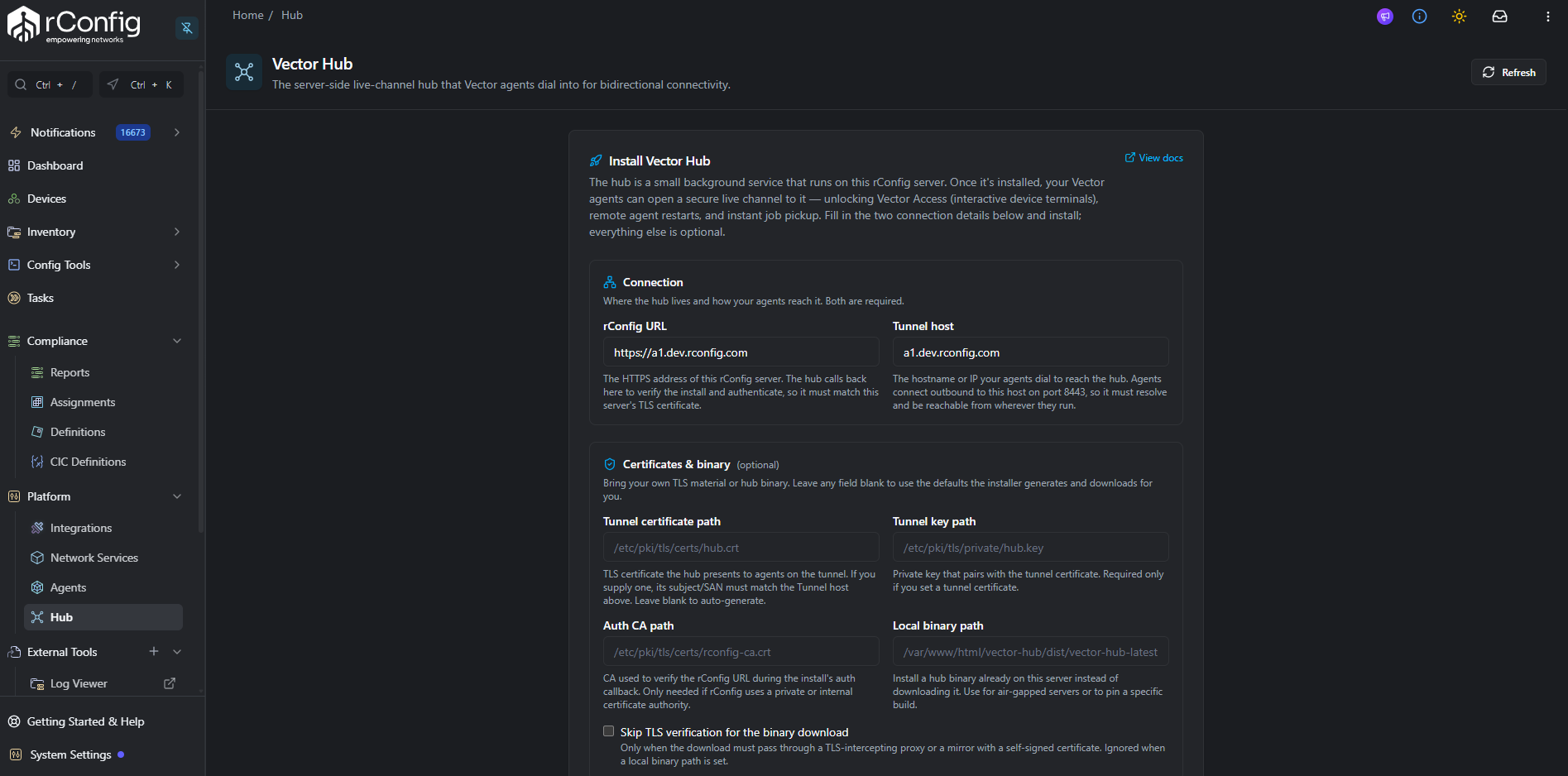
In the Install Vector Hub card, fill in the fields below.
Field Required Meaning rConfig URL Yes The rConfig app URL the hub calls back to. Tunnel host Yes Hostname or IP agents dial for the tunnel. Becomes wss://<host>:8443/tunnel.Auth CA path No CA used to verify the auth callback. Local binary path No Installs this local hub binary and skips the download. Tunnel cert path Yes TLS certificate presented on the public tunnel. Tunnel key path Yes Private key for the tunnel certificate. Skip TLS verification for the binary download Checkbox Bypasses certificate checks when fetching the binary. Use only in labs or with self-signed setups. -
Click Install Hub.
-
Watch the status badge. It shows the install state and exit code only, never the raw command output.
When the install succeeds, the page switches from the install card to the hub dashboard.
Install from a terminal
Section titled “Install from a terminal”The UI runs a shell script rendered from the install-hub.sh.blade.php template. The same script can be run manually as root on the rConfig server. In one pass it:
- Installs or updates the hub binary. It downloads
https://dl.rconfig.com/download-vector-hub/vector-hub-latestand its.sha256checksum unless a local binary path was supplied. - Generates an internal CA and leaf certificates: the loopback API certificate (
api.crt, SANIP:127.0.0.1,DNS:localhost), the tunnel certificate (tunnel.crt), and a Laravel client certificate (laravel-client.crt, withclientAuth). - Generates the shared secret
VECTOR_HUB_AUTH_SECRET, or reuses an existing one. - Writes the hub environment file and the
vector-hub.servicesystemd unit. - Copies the client certificate, key, and CA into
storage/app/vector-hub/asclient.crt,client.key, andca.crt, and writes theVECTOR_HUB_*keys into rConfig’s.env. - Runs a health check and verifies the auth callback.
How does rConfig decide the hub is installed?
Section titled “How does rConfig decide the hub is installed?”rConfig treats the hub as installed when the binary exists at VECTOR_HUB_BIN_PATH (default /usr/local/bin/rconfig/activehub/vector-hub).
Uninstall the hub
Section titled “Uninstall the hub”Run the install script with --uninstall. It removes the service, the binary, and the TLS material, and strips the VECTOR_HUB_* keys from .env. Agents fall back to timer-based polling.
How do I enable the live channel on an agent?
Section titled “How do I enable the live channel on an agent?”The live channel is per agent and off by default. Turn it on in either place:
- Agent edit dialog: navigate to Settings > Agents, edit the agent, and set the toggle to Live Channel Enabled. The help text reads “Enables bidirectional connectivity for this agent (hub live channel).”
- Hub page: click the Enable button on the agent’s row in the Agents card.
Enabling sets the agent’s desired state. The agent then dials the hub, and once the tunnel is up rConfig records the observed state and shows the agent as connected. Each enable or disable is written to the agent audit log as Live channel enabled/disabled for agent <name>.
| Status | Colour | Meaning |
|---|---|---|
| Connected | Green | Enabled and a live tunnel is up. |
| Enabled · waiting | Amber | Enabled, but the agent has not dialled in yet. |
| Disabled | Grey | The live channel is off for this agent. |
The scheduled command vector:hub-sync-status refreshes the connection state, round-trip latency, and last-seen time every minute.
What does the Hub page show?
Section titled “What does the Hub page show?”The Hub page (/hub, titled Vector Hub) shows KPI tiles, including service status, and an Agents card listing each agent’s live-channel status and actions. The roster is built to stay usable with 100+ agents:
- Server-side pagination: page size between 5 and 100, with “Page X of Y” and Previous/Next controls.
- Search by name or ID: the box labelled “Search agents by name or ID…” matches the agent name or its numeric ID.
- Enabled agents first: rows are ordered with enabled agents at the top, then alphabetically by name.
- Built-in agent hidden: the built-in vector-server agent (ID 1) is not a live-channel participant and does not appear.
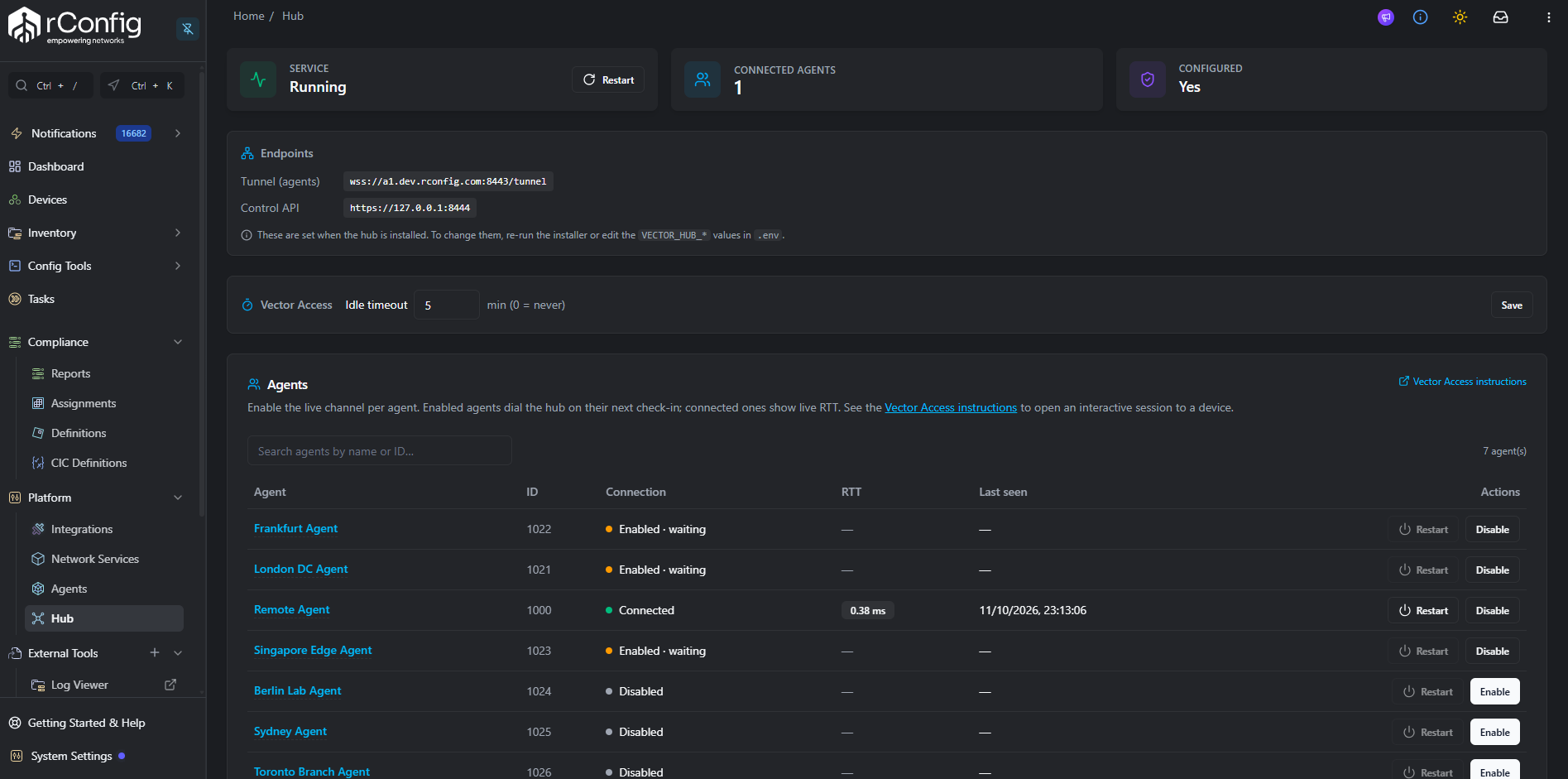
The page also holds the Vector Access panel, which sets the Vector Access idle timeout.
How do I SSH to a device through its agent?
Section titled “How do I SSH to a device through its agent?”Use Vector Access. It opens a live, optionally recorded SSH session to a device through its agent’s live channel, run on the rConfig server with php artisan vector:access. The session idle timeout is set in the Vector Access panel on the Hub page.
How do I restart an agent remotely?
Section titled “How do I restart an agent remotely?”- Open the Hub page and find the agent in the Agents roster.
- Click Restart. The button is only active when the agent’s live channel is connected.
- Click Confirm at the “Restart <name>?” prompt.
rConfig pushes the restart over the live channel. The agent acknowledges, exits gracefully, and its supervisor (systemd with Restart=always) starts it again. Agents installed the standard way run under systemd and come back automatically.
How does auto job pickup work?
Section titled “How does auto job pickup work?”Without the live channel, an agent finds new work on its next scheduled poll, so a job can wait up to one poll interval. With the live channel enabled, rConfig nudges the agent to poll the moment a job is queued for it, so jobs start near-instantly.
- It applies only to agents with the live channel enabled. Other agents keep polling on their timer.
- It is best-effort. If the agent is briefly disconnected or the hub is unreachable, the agent still picks the job up on its next normal poll.
- Bursts of queued jobs are debounced into a single nudge within a few seconds, and the agent collapses repeated nudges into at most one extra fetch.
There is nothing to configure. Enabling the live channel is enough.
How do the certificates self-heal?
Section titled “How do the certificates self-heal?”rConfig talks to the hub using client.crt, client.key, and ca.crt in storage/app/vector-hub/. If those files are lost, for example after a storage wipe, redeploy, or permissions reset, the hub would appear to be not responding. rConfig recovers them automatically:
- Every minute:
vector:hub-sync-statuschecks the hub. If the hub is unreachable, installed, and the client certificates are missing, it dispatches a re-sync job that copies the files back from the hub’s TLS directory (default/etc/vector-hub/tls) with ownership the web server can read. This auto-heal runs at most once every 5 minutes. - On page load: if the Hub page detects missing certificates, it triggers one re-sync automatically. The service KPI tile shows Certs missing, and an amber Hub client certificates missing banner offers a manual Re-sync certificates button.
Missing certificates are usually restored within about a minute, or immediately when the Hub page is opened.
Common gotchas
Section titled “Common gotchas”Configuration reference
Section titled “Configuration reference”The hub integration lives in the hub block of config/vector-server.php. If hub.api_url is unset, the hub integration is disabled entirely.
| Config key | Env var | Example / default | Meaning |
|---|---|---|---|
hub.tunnel_url | VECTOR_HUB_TUNNEL_URL | wss://rconfig.local:8443/tunnel | Tunnel URL delivered to agents. |
hub.api_url | VECTOR_HUB_API_URL | https://127.0.0.1:8444 | Control API (loopback mTLS). Unset disables the hub. |
hub.session_addr | VECTOR_HUB_SESSION_ADDR | 127.0.0.1:8445 | Session broker used by vector:access. |
hub.auth_secret | VECTOR_HUB_AUTH_SECRET | (generated) | Shared secret between rConfig and the hub. |
hub.client_cert | VECTOR_HUB_CLIENT_CERT | storage/app/vector-hub/client.crt | mTLS client certificate. |
hub.client_key | VECTOR_HUB_CLIENT_KEY | storage/app/vector-hub/client.key | mTLS client key. |
hub.ca_cert | VECTOR_HUB_CA_CERT | storage/app/vector-hub/ca.crt | CA used to verify the hub. |
hub.bin_path | VECTOR_HUB_BIN_PATH | /usr/local/bin/rconfig/activehub/vector-hub | Hub binary path. Its presence means installed. |
hub.tls_source_dir | VECTOR_HUB_TLS_SOURCE_DIR | /etc/vector-hub/tls | Source directory for the certificate re-sync. |
The hub binary reads its own environment:
| Env var | Default | Meaning |
|---|---|---|
VECTOR_HUB_TUNNEL_ADDR | :8443 | Public tunnel listener. |
VECTOR_HUB_API_ADDR | 127.0.0.1:8444 | Control API listener. |
VECTOR_HUB_SESSION_ADDR | 127.0.0.1:8445 | Session broker listener. |
VECTOR_HUB_AUTH_SECRET | (generated) | Shared secret. |
VECTOR_HUB_HEARTBEAT_INTERVAL | 15s | Tunnel heartbeat interval. |
The log level defaults to info.
Two related agent-run watchdogs sit outside the hub block: task_unit_timeout_seconds (VECTOR_TASK_UNIT_TIMEOUT_SECONDS, default 300) limits each device run, and task_run_wait_timeout_seconds (VECTOR_TASK_RUN_WAIT_TIMEOUT_SECONDS, default 900) caps the overall run.
Troubleshooting
Section titled “Troubleshooting”Why is the Restart button greyed out?
Section titled “Why is the Restart button greyed out?”Cause: the agent’s live channel is not connected. The tooltip reads “Agent must have its live channel connected to restart”.
Fix: enable the live channel and wait for Connected. Status refreshes every minute.
Why does the hub show Certs missing or not responding?
Section titled “Why does the hub show Certs missing or not responding?”Cause: the client certificates in storage/app/vector-hub/ are missing, usually after a storage wipe, redeploy, or permissions reset.
Fix: wait about a minute for the scheduled re-sync, or open the Hub page and click Re-sync certificates. If it persists, confirm the source files exist in /etc/vector-hub/tls and that the rConfig scheduler is running.
Why wasn’t a job picked up instantly?
Section titled “Why wasn’t a job picked up instantly?”Cause: auto job pickup only applies to live-channel-enabled agents, and the nudge is best-effort. If the agent was disconnected or the hub unreachable when the job was queued, the nudge is skipped.
Fix: none needed. The agent picks the job up on its next normal poll. To get instant pickup, enable the live channel and confirm the agent shows Connected.
Where are the Vector Access troubleshooting steps?
Section titled “Where are the Vector Access troubleshooting steps?”See Vector Access troubleshooting for session errors and finding transcripts.
Quick reference
Section titled “Quick reference”| I want to… | Do this |
|---|---|
| Install the hub | Hub page > fill in the install card > Install Hub (or run the install script as root). |
| Turn on the live channel for an agent | Settings > Agents > edit agent > Live Channel Enabled (or the Enable button on the Hub page). |
| See which agents are live | Hub page roster > Connected / Enabled · waiting / Disabled. |
| SSH to a device through its agent | php artisan vector:access <device> (or run with no argument and pick). See Vector Access. |
| Record an SSH session | php artisan vector:access <device> --log. Transcript in storage/logs/vector-ssh/. |
| Change the SSH idle timeout | Hub page > Vector Access panel > Idle timeout (minutes, 0 = never). |
| Restart an agent | Hub page roster > Restart (active only when connected). |
| Get jobs picked up instantly | Enable the live channel. Auto job pickup is automatic. |
| Fix “certs missing” | Wait about a minute, or Hub page > Re-sync certificates. |
| Remove the hub | Run the install script with --uninstall. |